
Why serious AI adoption depends on context architecture, data readiness, governance, and security control
Most organisations are no longer asking whether AI can be useful.
They already know it can.
The harder question is whether AI can be trusted inside the real operating environment of a business:
- messy corporate data
- legacy systems
- regulated workflows
- customer commitments
- staff using public tools
- unclear source ownership
- security and compliance pressure
- AI agents with access to tools, files, and APIs
This is where many AI projects get stuck.
The demo works. The pilot impresses. The prototype produces something useful. But the moment the system has to touch production data, answer from approved sources, respect permissions, avoid hallucinations, survive audit review, or integrate with existing infrastructure, the project slows down.
That is not a model problem.
It is an operating architecture problem.
At Axiom Studio, we built the Enterprise AI Control Stack for exactly this point in the adoption curve.
It is a collection of four premium technical protocols for teams, consultants, founders, architects, and operators who want to move beyond AI experimentation and build systems with structure, controls, and implementation discipline.
Explore the full Enterprise AI Control Stack
The four layers every production AI system needs
A serious enterprise AI system is not just a model connected to a chat interface.
It is a stack.
It needs a data layer, a retrieval layer, a context layer, a governance layer, and a security layer. Each layer has a different job, and each layer can become the reason the whole system fails.
If the data is messy, retrieval becomes unreliable.
If retrieval is weak, the context window becomes noisy.
If the context window is unmanaged, the model becomes easier to mislead.
If agents are given tools without control gates, automation becomes operational risk.
If employees use public AI tools outside approved systems, sensitive data can leave the business silently.
The Enterprise AI Control Stack is designed around those four major failure points:
- Context architecture: how information enters and gets used by the model.
- Data remediation: how corporate data becomes retrieval-ready.
- Agent governance: how autonomous AI workflows are controlled and audited.
- Shadow AI security: how unauthorized AI usage is discovered and contained.
Together, these four products form a practical operating system for production AI readiness.
1. Enterprise LLM Context Window Optimisation Blueprint
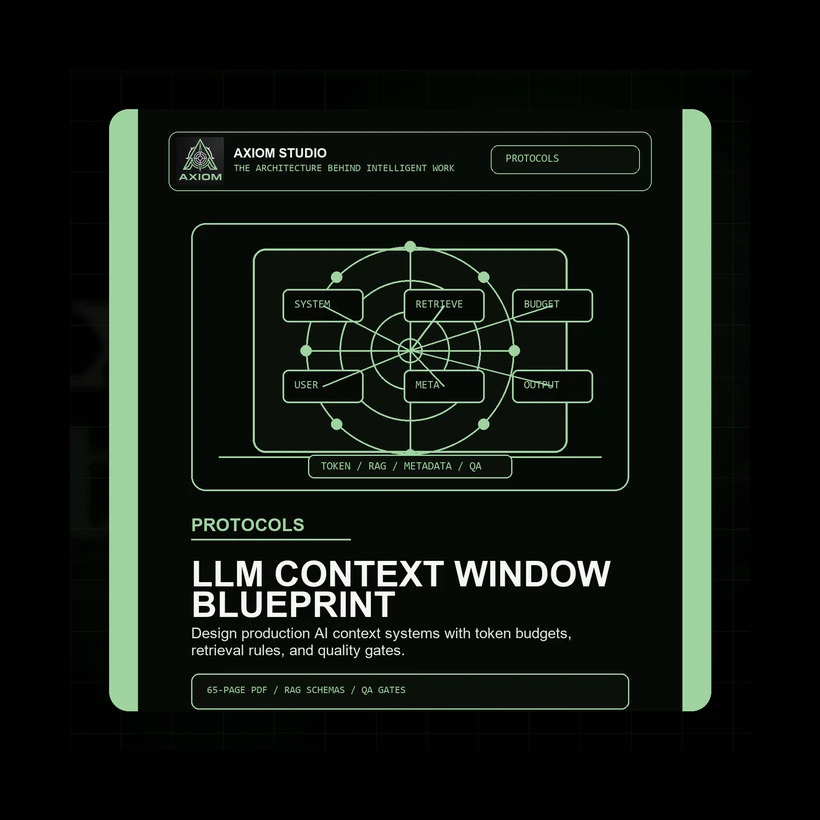
The first control layer is the context window.
Most businesses think of the context window as a bigger box for more information. That is the wrong mental model.
In production AI systems, the context window is an operating surface. It decides what the model sees, what it ignores, what it treats as instruction, what it treats as evidence, and what it has enough room to explain.
When the context window is unmanaged, teams run into the same problems again and again:
- too much irrelevant retrieved material
- weak token budgeting
- source evidence mixed with user instruction
- outdated data crowding out current policy
- examples consuming room needed for output
- no clear rule for compression or exclusion
- RAG chunks arriving without useful metadata
The Enterprise LLM Context Window Optimisation Blueprint gives teams a technical protocol for designing how information gets selected, ordered, compressed, labelled, and verified before it reaches the model.
It covers token budgeting, retrieval architecture, RAG chunking strategy, metadata schemas, prompt packet design, evaluation gates, governance controls, and implementation worksheets.
This is valuable for anyone building customer-facing assistants, internal knowledge tools, research workflows, support copilots, or retrieval-based AI systems.
The practical outcome is simple:
The model gets a cleaner operating surface, and the team gets a repeatable way to control the information entering that surface.
View the Context Window Optimisation Blueprint
2. Enterprise Data Remediation & Pipeline Hardening Blueprint
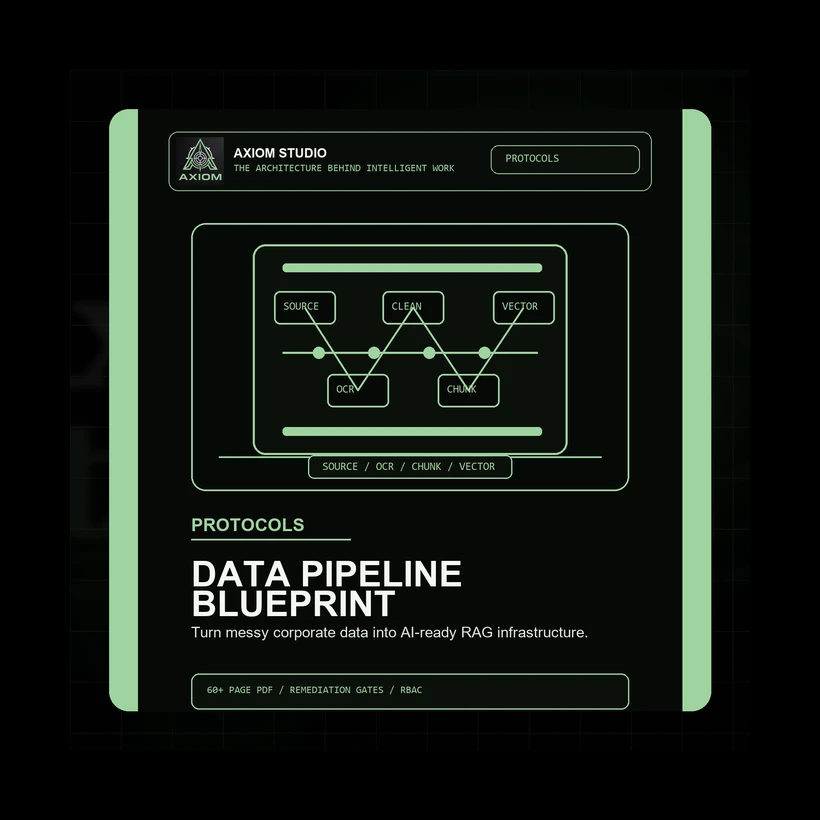
Before an AI system can answer from company knowledge, the company knowledge has to be usable.
That sounds obvious, but it is where many RAG projects break.
Corporate data is rarely clean, current, structured, permissioned, and ready for retrieval. It is usually scattered across file shares, SharePoint folders, old PDFs, scanned documents, CRM records, support exports, spreadsheets, internal wikis, database tables, and legacy applications.
Connecting AI to that environment without remediation creates a retrieval layer full of noise.
The Enterprise Data Remediation & Pipeline Hardening Blueprint focuses on the data foundation underneath enterprise AI.
It gives teams a technical implementation framework for turning fragmented corporate data into AI-ready RAG infrastructure.
Inside, it covers:
- AI data readiness assessment
- legacy source extraction
- change data capture strategy
- OCR and unstructured document processing
- duplicate, obsolete, and trivial data removal
- structural Markdown and JSON-LD conversion
- PII, PCI, secrets, and IP redaction gates
- entity resolution and knowledge graph links
- context-aware chunking
- metadata enrichment
- embedding model selection
- hybrid retrieval design
- vector database hardening
- TTL, cache invalidation, and RBAC controls
This blueprint is for the teams who understand that “clean your data” is not a strategy.
The real work is building a controlled pipeline where data can be extracted, cleaned, classified, chunked, embedded, permissioned, refreshed, and audited.
That is the difference between a RAG demo and a retrieval system the business can rely on.
View the Data Remediation & Pipeline Hardening Blueprint
3. Enterprise Multi-Agent AI Guardrail & Governance Framework
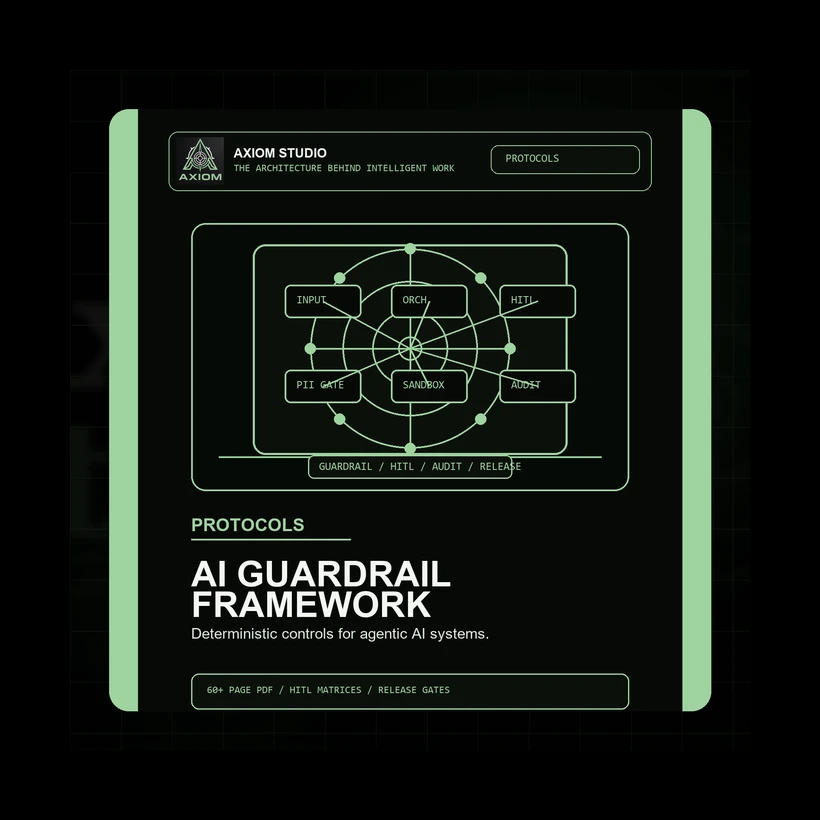
Once AI systems become agentic, the risk changes.
A single assistant drafting an answer is one thing.
A multi-agent workflow that can call tools, retrieve data, hand work between agents, execute actions, create recommendations, or trigger downstream systems is something else entirely.
At that point, the business needs more than “good prompts.”
It needs deterministic control layers.
The Enterprise Multi-Agent AI Guardrail & Governance Framework is built for the transition from impressive AI pilot to governed production workflow.
It helps teams define:
- what agents are allowed to do
- which tools they can call
- when they must stop
- when a human must approve
- how state transitions are controlled
- how outputs are checked against evidence
- how risky actions are contained
- how incidents are logged and reviewed
- what release evidence is required before production use
The framework covers governance architecture, input guardrails, agent orchestration controls, tool execution and sandbox hardening, blast-radius limits, grounding verification, human-in-the-loop gates, auditability, observability, rollback, and production release standards.
This is especially useful for consultants, automation agencies, CTOs, enterprise architects, and product teams building AI workflows that need to perform real business operations.
The goal is not to remove autonomy.
The goal is to make autonomy bounded, inspectable, and safe enough to use.
View the Multi-Agent Guardrail & Governance Framework
4. Corporate Shadow AI Mitigation & Security Manifest
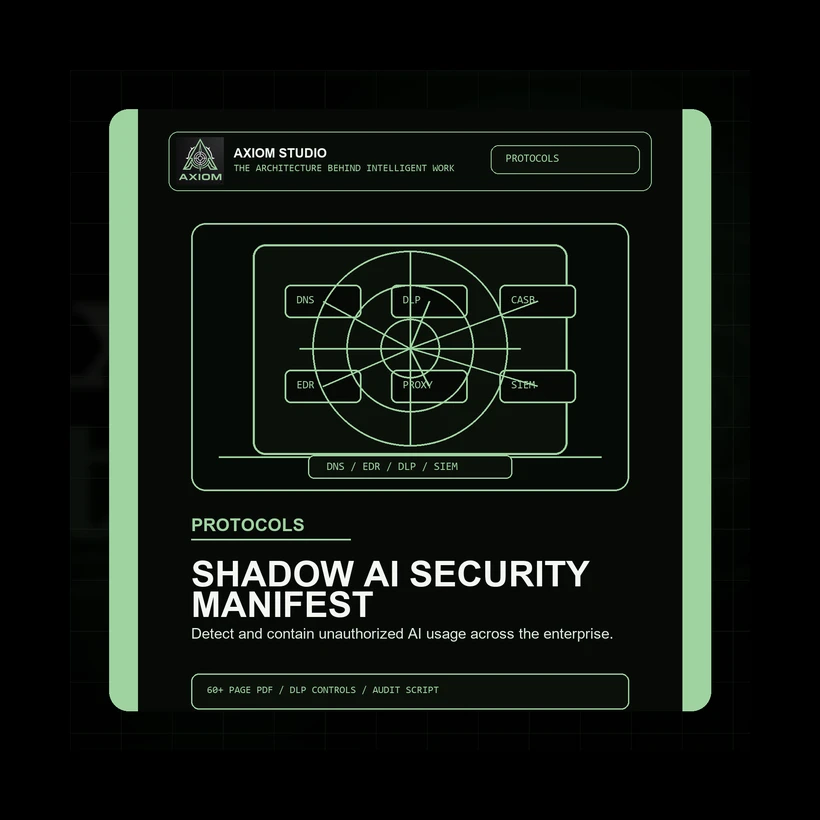
The final layer is security.
Even if a company builds an approved AI system, employees may still use public AI tools outside the official environment.
They paste customer data into consumer chat tools.
They install browser extensions that inspect page content.
They connect cloud storage to AI apps through OAuth.
They use personal API keys.
They test proprietary source code in unmanaged developer assistants.
That is Shadow AI.
The risk is not theoretical. It is operational, quiet, and difficult to control with policy alone.
The Corporate Shadow AI Mitigation & Security Manifest gives IT and security teams a technical framework for detecting, containing, and governing unauthorized AI usage across the enterprise.
It covers:
- Shadow AI threat mapping
- DNS and URL classification
- secure web gateway controls
- deep packet inspection
- CASB discovery
- endpoint auditing
- browser GPO hardening
- OAuth and API key audits
- DLP regex and content fingerprinting
- corporate AI proxy gateway architecture
- SIEM logging schemas
- incident response playbooks
- offboarding and supply-chain exposure audits
- a copy-ready PowerShell browser extension audit script
This product is designed for IT Directors, CISOs, network security engineers, infrastructure teams, cloud compliance officers, and security consultants.
The core argument is clear:
Shadow AI does not disappear because the business says “do not use it.”
It disappears when unauthorized usage becomes visible, sanctioned access becomes easier, and high-risk data movement is technically enforceable.
View the Shadow AI Mitigation & Security Manifest
Why these four products belong together
Each product solves a different part of the enterprise AI readiness problem.
The context blueprint controls the model’s working surface.
The data pipeline blueprint prepares the knowledge layer feeding retrieval.
The guardrail framework controls autonomous workflows and agent decisions.
The Shadow AI manifest protects the business from uncontrolled AI usage outside approved systems.
You can use them individually, but they are strongest as a stack.
Together, they help answer the questions that matter before AI touches meaningful business operations:
- Is the source data usable?
- Is the retrieval layer governed?
- Is the context window controlled?
- Are agent actions bounded?
- Are outputs verified?
- Are human approval gates defined?
- Are logs and audit trails available?
- Are security controls enforced?
- Are employees given a sanctioned route for AI work?
- Can the system be monitored, improved, and rolled back?
That is what production AI requires.
Not hype.
Not scattered prompt experiments.
Not another pilot that never reaches operational trust.
It requires an operating stack.
Explore the Enterprise AI Control Stack
The Enterprise AI Control Stack is built for teams who want to move from experimentation to structured implementation.
It is for operators who understand that AI success depends on architecture, data quality, governance, security, and repeatable workflow design.
Explore the full collection here:
View the Enterprise AI Control Stack
Or go directly to each product:
- Enterprise LLM Context Window Optimisation Blueprint
- Enterprise Data Remediation & Pipeline Hardening Blueprint
- Enterprise Multi-Agent AI Guardrail & Governance Framework
- Corporate Shadow AI Mitigation & Security Manifest
The future of enterprise AI will not be won by the team with the most experiments.
It will be won by the teams that build the strongest operating layer around intelligent work.